All submissions of the EM system will be redirected to Online Manuscript Submission System. Authors are requested to submit articles directly to Online Manuscript Submission System of respective journal.

Editorial

, Volume: 21( 4)

Role of Remote Sensing in Environmental Monitoring

 Mohamed El-Karim*

Department of Geospatial and Environmental Sciences, King Saud University, Saudi Arabia,

*Corresponding author: Mohamed El-Karim. Department of Geospatial and Environmental Sciences, King Saud University, Saudi Arabia,

Email: mohamed.elkarim.env@geospatial.edu.sa


Abstract


 Abstract


Remote sensing has become an indispensable tool for environmental monitoring by providing timely, accurate, and large-scale information about the Earth’s surface and atmosphere. Advances in satellite and sensor technologies enable continuous observation of environmental parameters such as land use change, deforestation, air and water quality, and climate variability. Remote sensing supports effective environmental assessment, management, and policy formulation. This article examines the role of remote sensing in environmental monitoring and highlights its applications in addressing contemporary environmental challenges.          


Keywords: Remote sensing, environmental monitoring, satellite imagery, land use change, environmental management

Introduction

 Environmental monitoring is essential for understanding changes in natural systems and assessing the impacts of human activities on the environment. Traditional ground-based monitoring methods, while accurate at local scales, are often limited in spatial coverage and temporal frequency [1]. Remote sensing overcomes these limitations by providing comprehensive and repetitive observations across large geographic areas. Remote sensing involves the acquisition of information about the Earth’s surface and atmosphere using sensors mounted on satellites, aircraft, and drones [2]. These sensors measure reflected or emitted electromagnetic radiation, enabling the analysis of land cover, vegetation health, water quality, and atmospheric conditions. Satellite data have become increasingly accessible, enhancing their use in environmental research and decision-making [3]. One of the key applications of remote sensing is monitoring land use and land cover change, including deforestation, urban expansion, and agricultural practices [4]. Such information is critical for understanding environmental degradation, habitat loss, and climate change impacts. Remote sensing also supports disaster monitoring by providing early warnings and damage assessments for floods, droughts, cyclones, and wildfires. Remote sensing contributes significantly to climate and environmental studies by enabling long-term observation of environmental trends and variability [5]. Integration of remote sensing data with geographic information systems and field observations enhances accuracy and applicability. The use of remote sensing is essential for informed environmental management and sustainable development planning.

 Conclusion

Remote sensing plays a vital role in environmental monitoring by providing large-scale, timely, and reliable data on environmental conditions and changes. Its applications support effective assessment of land use dynamics, ecosystem health, and climate variability. Advances in sensor technology and data accessibility have further strengthened its contribution to environmental management. Integrating remote sensing with ground-based observations and policy frameworks is essential for addressing complex environmental challenges and achieving sustainable development.

                                                                                     REFERENCES

1.       De Leeuw J, Georgiadou Y, Kerle N D. The function of remote sensing in support of environmental policy. Remote sensing. 2010 Jul 12;2(7):1731-50. 

2.       Faisal K, AlAhmad M, Shaker A. Remote sensing techniques as a tool for environmental monitoring. The International Archives of the Photogrammetry, Remote Sensing and Spatial Information Sciences. 2012 Jul 30;39:513-8.

3.       Krapivin V, Shutko AM. Information technologies for remote monitoring of the environment. Springer Science & Business Media; 2012 Jun 12.

4.       Jiao Z. The application of remote sensing techniques in ecological environment monitoring. Highlights in Science, Engineering and Technology. 2024;81:449-55.


5.       Odongo R. Remote sensing applications in environmental monitoring. European Journal of Natural Sciences. 2023;1(1):1-2.
Awards Nomination

Table of Contents

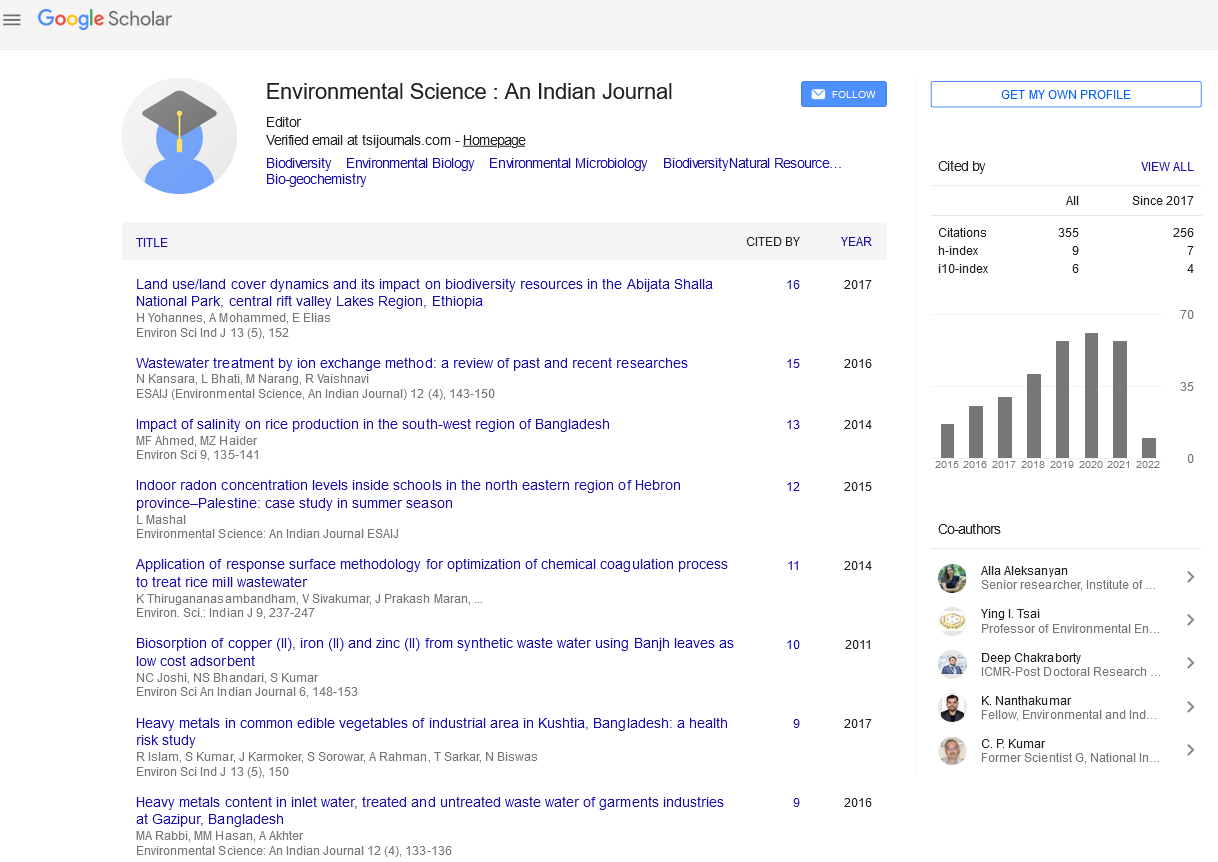
Google Scholar citation report
Citations : 543

Environmental Science: An Indian Journal received 543 citations as per Google Scholar report

Indexed In

  • CASS
  • Google Scholar
  • Open J Gate
  • China National Knowledge Infrastructure (CNKI)
  • CiteFactor
  • Cosmos IF
  • Directory of Research Journal Indexing (DRJI)
  • Secret Search Engine Labs
  • Scholar Article Impact Factor (SAJI))
  • ICMJE

View More

Flyer