All submissions of the EM system will be redirected to Online Manuscript Submission System. Authors are requested to submit articles directly to Online Manuscript Submission System of respective journal.

Editorial

, Volume: 21( 3)

Climate-Smart Agriculture Practices

Adebayo Olusegun *

Department of Sustainable Agriculture and Climate Studies, Obafemi Awolowo University, Nigeria,

*Corresponding author: Adebayo Olusegun. Department of Sustainable Agriculture and Climate Studies, Obafemi Awolowo University, Nigeria,

Email: adebayo.olusegun.env@agricultureuni.ng

Received: sep  04, 2025; Accepted: sep  18, 2025; Published: sep  27, 2025

Abstract


 Abstract

Climate-smart agriculture (CSA) is an integrated approach that aims to enhance agricultural productivity, strengthen resilience to climate change, and reduce greenhouse gas emissions. Increasing climate variability, rising temperatures, and frequent extreme weather events have intensified risks to agricultural systems worldwide. Climate-smart agriculture practices promote sustainable land use, efficient resource management, and adaptive farming techniques. This article examines key climate-smart agriculture practices and their role in improving food security, climate resilience, and environmental sustainability.     

 Keywords: Climate-smart agriculture, sustainable farming, climate resilience, food security, adaptation strategies

Introduction

 Agriculture is highly vulnerable to climate change due to its dependence on temperature, rainfall, and seasonal patterns. Increasing climate variability has negatively affected crop yields, livestock productivity, and farmer livelihoods, particularly in developing regions [1]. Climate-smart agriculture has emerged as a holistic framework that addresses these challenges by integrating adaptation, mitigation, and productivity goals.Climate-smart agriculture practices include conservation agriculture, crop diversification, agroforestry, improved water management, and climate-resilient crop varieties [2]. These practices enhance soil health, improve water-use efficiency, and reduce vulnerability to climate extremes. By maintaining soil organic matter and reducing erosion, CSA practices contribute to long-term agricultural sustainability [3].In addition to adaptation benefits, climate-smart agriculture can reduce greenhouse gas emissions through improved nutrient management, reduced tillage, and efficient livestock practices [4]. Lower emissions contribute to climate change mitigation while improving farm efficiency. Adoption of CSA practices is influenced by factors such as access to knowledge, financial resources, and supportive policies.Climate-smart agriculture also offers socio-economic benefits by increasing farm incomes, enhancing food security, and strengthening rural resilience [5]. However, scaling up CSA requires capacity building, investment, and institutional support. Integrating climate-smart agriculture into national agricultural policies is essential for addressing climate risks and promoting sustainable development.

 Conclusion

Climate-smart agriculture practices provide an effective pathway for addressing the challenges posed by climate change to agricultural systems. By enhancing resilience, improving productivity, and reducing emissions, CSA supports sustainable food production. Promoting CSA adoption through policy support, farmer training, and research innovation is crucial for building resilient agricultural systems. Climate-smart agriculture will play a key role in ensuring food security and environmental sustainability under changing climatic conditions.

                                                                                     REFERENCES

1.       Wakweya RB. Challenges and prospects of adopting climate-smart agricultural practices and technologies: Implications for food security. Journal of Agriculture and Food Research. 2023 Dec 1;14:100698.       

2.       Lipper L, Thornton P. Climate-smart agriculture for food security. Nature climate change. 2014 Dec;4(12):1068-72.

3.       Chandra A, McNamara KE, Dargusch P. Climate-smart agriculture: perspectives and framings. Climate Policy. 2018 Apr 21;18(4):526-41.

4.       Bai X, Huang Y, Ren W. Responses of soil carbon sequestration to climate?smart agriculture practices: A meta?analysis. Global change biology. 2019 Aug;25(8):2591-606.


5.       Victory GO, Oyewole AL, Olaitan AA. Climate-smart agricultural practices at Oyo State-Nigeria. South Asian Journal of Social Review. 2022 Jun 30;1(1):1-7.

Awards Nomination

Table of Contents

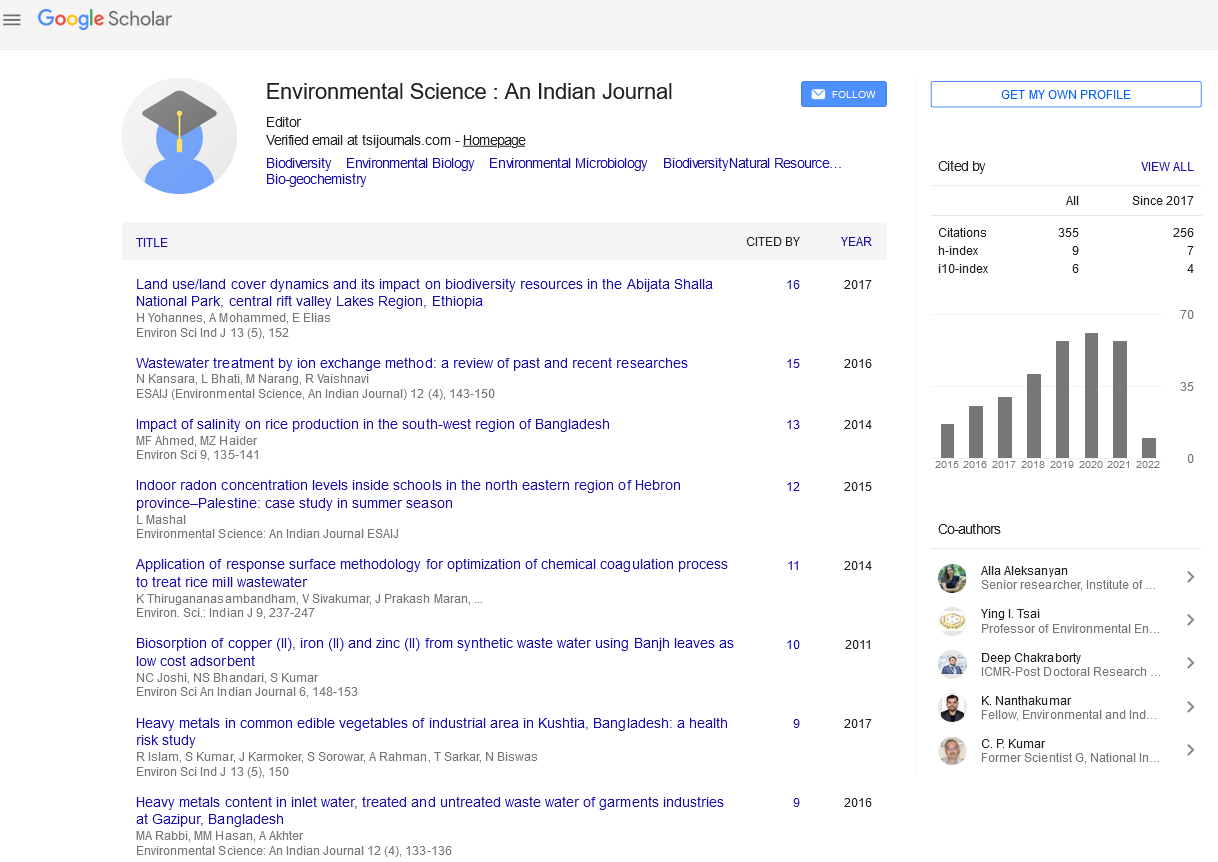
Google Scholar citation report
Citations : 543

Environmental Science: An Indian Journal received 543 citations as per Google Scholar report

Indexed In

  • CASS
  • Google Scholar
  • Open J Gate
  • China National Knowledge Infrastructure (CNKI)
  • CiteFactor
  • Cosmos IF
  • Directory of Research Journal Indexing (DRJI)
  • Secret Search Engine Labs
  • Scholar Article Impact Factor (SAJI))
  • ICMJE

View More

Flyer