Review
, Volume: 15( 1) DOI: 10.37532/2319-9822.2026.15(1).400Quantum Chronon Theory
- *Correspondence:
- Jemali Mtskerashvili
Department of Exact and Natural Sciences, Ivane Javakhishvili Tbilisi State University, Tbilisi, Georgia
E-mail:jmtsk7@gmail.com
Received date: November 09, 2024, Manuscript No. TSSE-24-152132; Editor assigned: November 12, 2024, PreQC No. TSSE-24-152132 (PQ); Reviewed: November 27, 2024, QC No. TSSE-24-152132; Revised: March 10, 2026, Manuscript No. TSSE-24-152132 (R);Published: March 17, 2026, DOI: 10.37532/2319-9822.2026.15(1).400
Citation: Mtskerashvili J. Quantum Chronon Theory. J Space Explor. 2026;15(1):400.
Abstract
This theory proposes a novel framework for unifying general relativity, quantum field theory, and quantum gravity by introducing a new class of elementary particles, termed chronons, which mediate the passage of time. In this framework, interactions between particles and chronons via chronon-coupling generate mass, with the particle’s mass being directly related to the strength and duration of its interaction with chronons. A particle’s mass is treated as a time-dependent operator, varying in response to its interactions with chronons over time. The theory suggests that the absence of chronon interaction corresponds to mass-less particles. This approach provides new insights into unresolved phenomena, including black holes, dark energy, dark matter, and the Big Bang, offering a potential path toward the unification of these otherwise disparate physical theories.
Keywords
Information; Time; Constants; Big Bang
Introduction
For decades, theoretical physicists have endeavored to unify General Relativity (GR) with Quantum Field Theory (QFT) in an attempt to explain gravity at the quantum level. Despite remarkable successes in both fields, these theories remain fundamentally incompatible when applied to extreme regimes, such as the small scales of quantum mechanics, the large scales of cosmology, or high-energy environments like black holes. GR, developed in the early 20th century, accurately describes gravity on large scales, but it breaks down at singularities and cannot incorporate quantum effects. On the other hand, QFT, the cornerstone of particle physics, governs the behavior of fundamental particles and forces at microscopic scales but does not include gravitational interactions [1].
Various attempts have been made to bridge this divide. String theory and Loop Quantum Gravity (LQG) are two prominent frameworks, each attempting to unite the quantum and gravitational realms. However, both face significant challenges: string theory struggles with its complexity and lack of experimental evidence, while LQG encounters difficulties in reconciling the discrete nature of space-time with the continuous structure described by GR. Other approaches, such as quantum gravity and the idea of gravitons, also encounter limitations when applied to the extreme environments of black holes or the early universe. The Quantum Chronon Theory (QCT) does not claim to offer a complete or definitive solution, but instead proposes a novel way of approaching the relation- ship between space, time, and matter [2]. By introducing chronons elementary particles that mediate time itself QCT suggests a new mechanism for the generation of mass and gravitational effects. This theory aims to overcome the limitations of previous approaches by offering a time-dependent treatment of mass and gravity, re-conceptualizing them as dynamic properties that evolve in response to the interactions between particles and chronons. Although QCT may not provide the final answer, it offers a fresh perspective on the fundamental structure of the universe, challenging conventional paradigms and inspiring new avenues for exploration [3].
The core concept of QCT is the chronon, an elementary particle that medi- ates the passage of time, much like how photons mediate the electromagnetic force and gravitons mediate gravity. The principle of a time-mediating particle is not new in theoretical physics various models have proposed such concepts in different forms, including ideas around the “Chronon” in older time-based theories and models of quantum gravity. What sets the chronon apart in QCT is that, in addition to mediating time, it also defines the mass of interacting particles. Chronons are associated with a corresponding chronon field, which governs the flow of time across space. Particles interacting with this chronon field gain mass as a result of these interactions, and this mass is time-dependent. The greater the strength of the interaction between a particle and the chronon field, the greater the mass that particle acquires [4].
Chronons are not distributed uniformly throughout space. This uneven distribution leads to mass anomalies, such as those observed in galaxies, which have historically been attributed to the presence of dark matter. According to QCT, the mass attributed to dark matter is actually a consequence of localized variations in the chronon field, influencing the distribution of matter and energy. Furthermore, QCT provides a novel explanation for the accelerated expansion of the universe. The theory proposes that negative pressure exerted on the chronons leads to the release of energy, driving the expansion observed in cosmological measurements akin to the effects attributed to dark energy in conventional cosmology [5].
QCT also offers a new perspective on black holes and their properties [6]. According to the theory, the density of chronons increases near the event horizon of a black hole, which leads to increase in the mass of particles inside the event horizon. As particles become heavier within the black hole, this intensifies the gravitational pull exerted on nearby objects, including photons. This explains why even light cannot escape the gravitational well of a black hole: the increased mass of photons and other particles near the event horizon, due to their interaction with the chronon field, makes their escape impossible.
Literature Review
Chronon dynamics and mass
In QCT, the mass of a particle is defined by its interaction with the chronon field over time. This time-dependent mass is expressed through the time-dependent mass operator mˆ is given by:

where m0 is the rest mass of the particle, α and β are the coupling constants that define the strength of the interaction of interaction between the particles and the chronon field and Φchronon (x, t) is the chronon field. The term αΦchronon (x, t) represents the intravenous coupling to the field, while term β∫40 Φchronon (x, t′) dt′ accounts for temporal mediation, where the history of chronon field influences the particle’s mass over time. This reflects the idea that the particle’s mass evolves due to its cumulative interaction with the chronon field [7].
It is important to note that the equation above does not yet account for renormalization to deal with infinities, a procedure that will be discussed in detail later in the paper.
The chronon field is treated as a quantum field, with the quantum operators for the field Φˆchronon(x, t) and its conjugate momentum Πˆchronon(x, t) satisfying the canonical commutation relation:

Here, Φˆchronon is the quantum operator for the chronon field, which is scalar and interacts with particles to influence both their mass and the curvature of spacetime. Πˆchronon is the conjugate momentum to the chronon field.
The Chronon field is dynamic and interacts with itself. These self-interactions are governed by the equation:

Where, is the d’Alembert operator to account for the kinetic energy of the field, λ1, λ2, λ3 are self-interaction constants that control the nature of the chronon field’s self-interactions, λ1Φˆchronon(x, t)3 refers to the non-linear self-interaction of the chronon field, λ2∂μΦˆchronon(x, t)∂μΦˆchronon(x, t) is the kinematic term, which accounts for the dynamic evolution of the chronon fields, and λ3Φˆchronon(x, t)?ˆΦˆchronon(x, t) represents a feedback mechanism, where the chronon field’s evolution influences its own future behavior over time.
These self-interactions play a crucial role in shaping the dynamics of the chronon field and its effects on the mass of particles and the curvature of space-time [8].
Renormalization of the chronon field
Renormalization is required to address the infinities that arise in the equations described above. To handle these infinities, a counter term is introduced, which allows for the subtraction of divergent contributions. This is expressed as:

Here, ∂Φˆchronon is the counter term that cancels the infinities appearing in the original field Φˆchronon. With this renormalized field Φˆrenchronon, we can now proceed to renormalize the mass and self-interaction formulas.
For the time-dependent mass operator, the renormalized mass becomes:

For the quantum commutation relation, the renormalized fields obey:

Finally, the re-normalized self-interaction equation for the chronon field takes the form:

Here, the self-interaction constants λren1, λren2, λren3 are the renormalized coupling constants. These renormalized equations now account for the infinities and provide a finite, physically meaningful description of the chronon field and its interactions.
Energy and evolution
General Relativity (GR) describes how the curvature of spacetime is influenced by energy and mass. In order to integrate Quantum Chronon Theory (QCT) into GR, we need to define the energy in terms of the chronon field and incorporate the mass-operator as described earlier. The total Hamiltonian energy of a system is the sum of the kinetic and potential energy operators:

where ˆH is the Hamiltonian, ˆ T and ˆ V represent the kinetic and potential energy operators, respectively. In QCT, we treat
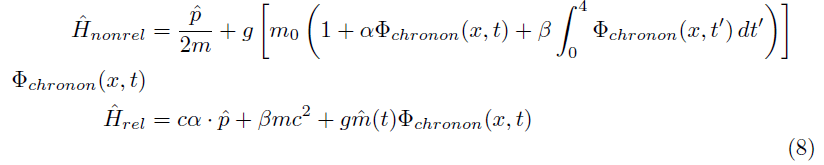
Hamiltonians both in relativistic (Dirac) and non-relativistic (Schr¨odinger) formalisms. For a non-relativistic particle, the kinetic and potential energy operators are given by:

where pˆ is the momentum operator, g is a coupling constant, mˆ (t) is the time-dependent mass of the particle, m0 is the rest mass of the particle, and Φchronon (x, t) is the chronon field at position x and time t.
For relativistic particles, we use the Dirac Hamiltonian form, where the kinetic term involves the Dirac matrices α and β:

where c is the speed of light, and α and β are the Dirac matrices. Since we are dealing with relativity, the kinetic energy term is not represented as pˆ2/2 m due to the relativistic nature of the particle [9].
Combining both the non-relativistic and relativistic Hamiltonians, we obtain the total Hamiltonian energy for the system:
To incorporate the chronon field into the Hamiltonian formulation, we introduce the renormalized chronon field operator Φren. Expanding the Hamilto-nian in terms of the field operators and treating the kinetic term as a Laplacian acting on the field, the Hamiltonian for the chronon field becomes:

where Hchronon is the Chronon Hamiltonian, m2Φ is the mass term for the chronon field, and Lint is the interaction Lagrangian between the chronon field and the matter field.
The interaction between the chronon field and matter is given by the following Lagrangian term:

where ψ(x, t) represents the matter field, and g is the coupling constant between the chronon field and matter.
The final form of the Chronon Hamiltonian, Hchronon, provides a renormalized framework for the chronon field, showing how it interacts with matter and how energy is distributed in the system according to QCT. This renormalized treatment ensures that the equations are physically meaningful and finite, accounting for the interaction between the chronon field, the mass of particles, and the curvature of spacetime.
The evolution of the chronon field can be described by Dirac’s equation, modified to include the time-dependent mass operator arising from the interaction with the chronon field. For a non-relativistic particle, the evolution of the wavefunction ψ(x, t) is governed by the Schr¨odinger-like equation:

Expanding the non-relativistic Hamiltonian Hnonrel from earlier, it becomes:

where ˆp is the momentum operator, m is the particle mass, g is the coupling constant, ˆm(t) is the time-dependent mass operator, and Φchronon(x, t) is the chronon field.
In the relativistic case, where the particle experiences both the chronon field and the relativistic effects, the evolution of the wave function is described by the Dirac equation in its relativistic form:

where c is the speed of light, α and β are the Dirac matrices, and mc2 is the rest energy of the particle. The term g ˆm(t)Φchronon(x, t) represents the coupling between the particle’s time-dependent mass and the chronon field.
These equations describe the time evolution of a quantum system under the influence of the chronon field, where the mass of the particle is not a fixed quantity but depends dynamically on its interaction with the chronon field, thus leading to a time-varying mass.
General relativity
Now that we have defined energy and mass in the context of the Quantum Chronon Theory (QCT), we can proceed with integrating QCT into General Relativity (GR). The key step involves formulating the Chronon Lagrangian density in QCT, which governs the dynamics of the chronon field and its interactions with matter and energy. The Chronon Lagrangian density is expressed as:

In this expression, the first term 1/2∂αΦchronon∂αΦchronon represents the kinetic energy of the chronon field, and the terms λ1, λ2, λ3 describe the selfinteractions of the chronon field, including potential interactions and higherorder kinematic terms.
From this Lagrangian density, we can derive the energy-momentum tensor for the chronon field, which captures how the chronon field influences spacetime curvature. The energy-momentum tensor is given by:

Here, ∂μΦchronon∂νΦchronon represents the flow of energy and momentum within the chronon field, while the term gμνLchronon subtracts the contribution of the chronon field’s own dynamics from the stress-energy tensor.
Next, we integrate this energy-momentum tensor for the chronon field into the Einstein field equations of general relativity. These equations describe the curvature of spacetime in terms of the distribution of matter and energy. The result is:

where Tmatterμν is the stress-energy tensor for ordinary matter and radiation, as described in classical GR, and Tchrononμν is the stress-energy tensor for the chronon field.

Where Tμν(Φchronon) is the contribution of the chronon field to the overall energy-momentum tensor, ˆΦchronon is the quantized version of the chronon field, and terms λ1, λ2, λ3 are the self-interaction constants for the chronon field. The presence of the operator ? represents the d’Alembertian, which is related to the spacetime curvature. Finally, meff represents the effective mass of the fermion, which is modified by its interaction with the chronon field. The effective mass is not constant, but instead depends on the interaction between the fermion and the chronon field, as dictated by the time-dependent nature of the mass operator in QCT.
Finally, the field equations that govern the dynamics of spacetime under the influence of both matter and the chronon field are:

In this framework, the chronon field plays a crucial role in shaping the structure of spacetime, introducing a time-dependent mass for particles through interactions with the chronon field. By integrating the chronon field’s energy- momentum tensor into Einstein’s equations, we derive a modified set of field equations that describe the curvature of spacetime under both the influence of ordinary matter and the chronon field. This integration provides new insights into phenomena such as dark matter, dark energy, and black holes, offering a unified approach to gravity and quantum mechanics that could pave the way for further theoretical advancements.
Discussion
The Quantum Chronon Theory (QCT) provides new explanations for several long-standing mysteries in physics, including the nature of black holes, dark matter, dark energy, and the accelerated expansion of the universe. At its core, QCT introduces chronons, elementary particles that mediate the passage of time and interact with matter to affect its mass and gravitational properties. These interactions between particles and the chronon field suggest a new frame- work for understanding mass, gravity, and the behavior of the universe on both microscopic and cosmological scales.
In the case of black holes, QCT proposes that the extreme gravitational effects near the event horizon are due to an increased density of the chronon field. As matter approaches the event horizon, its interaction with the chronon field strengthens, leading to an increase in the effective mass of particles. This explains why even massless particles, such as photons, cannot escape a black hole: the increased mass makes it impossible for them to overcome the black hole’s gravitational pull. Additionally, QCT suggests that the singularity at the center of a black hole may not be an infinite density, as traditionally thought.
The chronon field could modify this extreme condition, providing a resolution to the singularity problem that has plagued general relativity.
QCT also provides a novel explanation for dark matter. The gravitational anomalies observed in galaxies and galaxy clusters, which cannot be explained by the visible matter alone, are attributed to variations in the chronon field. Areas with a higher concentration of chronons exert stronger gravitational forces, which can account for the missing mass and the unexpected motions of galaxies. This means that what we have traditionally called dark matter could simply be a manifestation of the chronon field’s effects on ordinary matter, rather than the presence of unknown particles.
The theory also addresses dark energy and the accelerated expansion of the universe. QCT explains this acceleration by positing that the chronon field exerts a negative pressure that drives the repulsive force causing the universe’s expansion to speed up. In this model, dark energy is not a separate force but a consequence of the chronon field’s intrinsic properties. The theory provides a new perspective on the origin of dark energy and its role in the evolution of the cosmos.
In addition to these broad cosmological effects, QCT has specific, testable predictions that could be experimentally verified. One such prediction is the potential for modifications to gravitational dynamics. The interaction between matter and the chronon field could alter the propagation of gravitational waves. These changes might result in detectable differences in the speed or shape of gravitational waves, particularly in regions with high chronon field density, such as near black holes or dense cosmic structures. This could also lead to altered lensing effects, where the bending of light around massive objects might be influenced by the presence of the chronon field, creating detectable anomalies in gravitational lensing observations.
Another key testable prediction is the discreteness of time in extreme environments. QCT suggests that in regions of high chronon density, such as near black holes or during the early universe, time may behave as a discrete rather than continuous quantity. This could lead to detectable differences from continuous time in experiments designed to measure time at incredibly small scales. If time is quantized in such extreme conditions, it may be possible to observe these deviations in high-energy particle accelerators or in experiments investigating the behavior of atomic clocks in intense gravitational fields.
QCT also predicts quantum fluctuations in the chronon field, which could have a significant impact on phenomena such as vacuum energy and particle creation. These fluctuations could influence the value of the cosmological constant and the vacuum energy in ways that affect the overall energy density of the universe. Such effects could be detectable in high-precision measurements of the Cosmic Microwave Background (CMB) or in observations of galaxy formation, where small variations in the chronon field might influence the evolution of large-scale structures in the universe.
The theory also suggests that the mass fluctuations driven by the chronon field could affect particle interactions and decay rates. Because the chronon field modifies the mass of particles in a time-dependent manner, the interactions between particles could be altered, leading to changes in decay rates or the strength of fundamental forces. This could be observed in experiments measuring particle lifetimes, especially in environments where the chronon field’s influence is stronger, such as near black holes or other dense cosmic regions.
QCT predicts that time dilation effects could be altered in strong gravitational fields. In general relativity, time slows down near massive objects due to the warping of space time. In QCT, however, the chronon field could modify this time dilation, especially in regions with high chronon field density. This could lead to measurable differences in time dilation effects when compared to predictions from general relativity, particularly in environments with extreme gravity, such as near black holes or neutron stars.
Finally, QCT has implications for the early universe, offering a new explanation for cosmological inflation and the evolution of the cosmological constant. The chronon field could have played a critical role in the rapid expansion of the universe during inflation, as its negative pressure would drive the exponential expansion. This could offer a more unified understanding of the early universe’s dynamics, linking the inflationary period with the current accelerated expansion observed in the present-day universe.
Conclusion
In conclusion, the QCT introduces a novel perspective on the fundamental nature of time, mass, and gravity by proposing chronons as time-mediating particles that interact with matter to influence its mass and gravitational properties. Key findings include explanations for black hole dynamics, dark matter, dark energy, and the accelerated expansion of the universe. QCT also offers testable predictions, such as modifications to gravitational waves, time discreteness, and particle decay rates, which can guide future experiments. While still in its early stages, this theory opens new avenues for research in quantum gravity, cos- mology, and high-energy physics, offering the potential to reshape our under- standing of the universe. Future work should focus on experimental verification, particularly in gravitational wave detection, particle physics, and cosmological observations.
References
- Einstein A. Die Grundlagen der allgemeinen. Relativitats− teorie. Am J Phys. 1916;49:769.
- Feynman RP, Leighton RB, Sands M, et al. The feynman lectures on physics; vol. I. Am J Phys. 1965;33(9):750-752.
- Dirac PA. The quantum theory of the electron. Proceedings of the Royal Society of London. Series A, Containing Papers of a Mathematical and Physical Character. 1928;117(778):610-624.
- Bojowald M. Loop quantum cosmology. Living Rev Relativ. 200;11(1):4.
[Crossref] [Google Scholar] [PubMed]
- Hawking SW, Penrose R. The singularities of gravitational collapse and cosmology. Proceedings of the Royal Society of London. A. Mathematical and Physical Sciences. 1970;314(1519):529-548.
- Maldacena J. The Large-N limit of superconformal field theories and supergravity. Int J Theor Phys. 1999;38(4):1113-1133.
- Padmanabhan T. Cosmological constant—the weight of the vacuum. Phys Rep. 2003;380(5-6):235-320.
- Jacobson T. Thermodynamics of spacetime: The Einstein equation of state. Phys Rev Lett. 1995;75(7):1260.
[Crossref] [Google Scholar] [PubMed]
- Unruh WG. Experimental black-hole evaporation? Phys Rev Lett. 1981;46(21):1351.