Perspective
, Volume: 14( 1) DOI: 10.37532/2320-6756.2026.14(1).408Ehrenfest Paradox Explained: How Misapplication of Length Contraction Leads to Contradictions
- *Correspondence:
- Mueiz Gafer Kamal Eldeen
Department of Science, Sudan University of Science and Technology, Khartoum, Sudan
E-mail:mueizphysics@gmail.com
Received date: November 25, 2024, Manuscript No. TSPA-24-153262; Editor assigned: November 27, 2024, PreQC No. TSPA-24-153262 (PQ); Reviewed: December 11, 2024, QC No. TSPA-24-153262; Revised: January 14, 2026, Manuscript No. TSPA-24-153262 (R);Published: January 21, 2026, DOI. 10.37532/2320-6756.2026.14(1).408
Citation: Eldeen MGK. Ehrenfest Paradox Explained: How Misapplication of Length Contraction Leads to Contradictions. J Phys Astron. 2026;14(1):408.
Abstract
It can be clearly, simply and decisively explained that the Ehrenfest p aradox arises from an incorrect application of the length contraction rule, and that a correct analysis of the case of the rotating disk leads to the fact that the relationship between the radius and the circumference remains as usual
Keywords
Circumference ; Pulley s; Ehrenfest paradox; Lorentz t ransformation
Introduction
In a rotating disk, the disk’s circumference would experience length contraction due to the motion relative to an external observer while the radius does not, the usual relationship C=2πR appear to break down, this represents inconsistency in special relativity when applied to rotating objects [1]. This is Ehrenfest paradox, and I do not want to elaborate on its explanation or present its history and the solutions that have been offered to solve it or criticize those solutions [2]. These things have become available and access to them is very easy for those students and researchers who request them, but I would like in this introduction to point out her that this paradox represented something important to Einstein, and he mentioned it more than once in his writings on relativity [3] and made it the gateway that moves us from special relativity to general relativity.
I must also point out here that if it turns out to us that the paradox results from an incorrect application of the rule of length contraction and that it will not lead to general relativity in the way that Einstein envisioned, this does not mean questioning general or special relativity or its discoverer's understanding of them , but in fact, this was only a mistake in a thought experiment used by Einstein for an educational purpose which is to demonstrate a fact that he had arrived at in many ways, which is the necessity of introducing non-Euclidean geometry to build a complete theory of relativity, this thought experiment was not the basis of general relativity as Michelson- Morley's experiment was for special relativity [4].
Description
Misapplication of Lorentz Transformation
Suppose we have a long belt that transmits motion between two small pulleys of equal size separated by a distance of L. Accordingly, when the belt is stationary, the length of the part of the belt that passes above the two pulleys is L, as well as the lower part, so the total length of the belt is 2L (by neglecting the small parts wrapped around the two pulleys.)
Now we want to know what is the length of the belt when the two pulleys rotate and the belt moves at speed V (Figure 1).
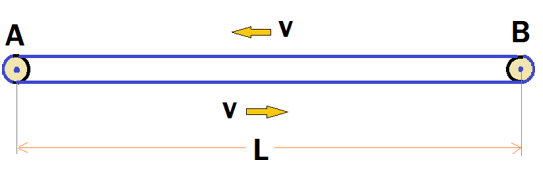
FIG. 1. Two small pulleys, between which the movement is transmitted by a long belt.
Here we might think that the length of the belt between A and B will change as a result of its movement according to the rule of length contraction, but this is not true. The length of the belt between points A and B will remain the same without any change regardless of the speed at which it is moving [5]. As a general rule, it should be clear that: If we have any long body that moves parallel to itself, we apply the length contraction rule if its two ends are moving with it, and we do not apply the length contraction rule to the length of the body that moves between two ends that are stationary with respect to us. The length of the train we see moving will be less than its length when it is at rest. But if we are looking from a window that is fixed for us and we see only part of the train, then the length of this part that we see from the window will depend only on the width of the window and will not differ at all if the train is stationary or moving.
Therefore, based on this correct understanding of the rule of length contraction, the length of the belt between points A and B is the same as L and is not affected by movement. Therefore, the relationship between the length of the belt and the distance between A and B will remain the same as before 2L′ = 2L = 2AB, and will not be anything else, such as 2L′ > 2AB or 2L′ < 2AB. What is affected by the length contraction rule is any part of the belt when we define it by its ends which are part of it and move with it, but this is an effect that the observer who studies geometric relationships usually does not care about [6].
Now, what we said about the belt stretched between two pulleys can be said about the circumference of the circle of the rotating disk (Figure 2). This circumference can be viewed as a belt stretched over a group of small pulleys distributed in a circle, so that the shape approaches the circle as we increase the number of pulleys.
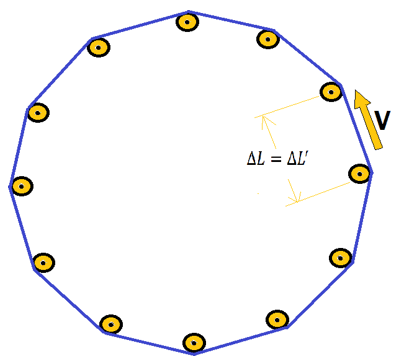
FIG. 2. A belt passes over many pulleys arranged in a circular shape. The lengths of a certain part of the belt at different speeds were compared, the ends of this part are two adjacent rollers.
The effect of Lorentz contraction will only appear if we look at a specific part of the belt such that both ends of this part are attached to the belt itself (Figure 3). For example, if we coloured part of the belt red.
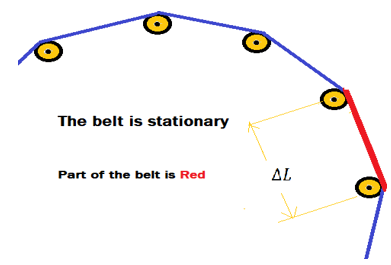
FIG. 3. The belt between two pulleys while at rest is colored red.
In this case, the length of this red part will shrink with respect to a stationary observer (Figure 4).
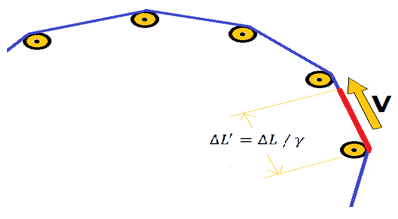
FIG. 4. We observe the length of the red part of the belt and find that it is shorter than its static length. This drawing has shortcomings that cannot be avoided.
But this does not lead to any changes in the geometry of the shape that lead to contradictions. What happens is simply that if the distance between each two pulleys requires a certain amount of the length of the static belt, for example: 1/12 of the total length of the belt to cover it, then it will need another part smaller than that part 1/12γ of the total stationed length of the belt if the belt is moving. Each part of the belt shrinks, but its ability to fill spaces increases. The only difficulty with this is that this idea cannot be represented by a static drawing like the drawing above. The idea of connecting two points with a moving straight line that is shorter than the static line that connects those two points cannot be represented by a static drawing and may be difficult to imagine, but in any case, it is one of those consequences of special relativity that contradict common sense. Therefore, the previous figure has an inevitable shortcoming, as it is not possible to simultaneously show the contraction of the red part of the belt and its ability to connect the same two points that are connected by another line that is longer than it but is stationary. We can simplify this idea if we return to the first drawing, which contains two pulleys and a belt. In this case, there is no doubt that the total length of the belt decreases by the Lorentz factor, but there is also no doubt that the distance between the two pulleys always remains filled with the belt.
Conclusion
The rule of length contraction is that anybody that moves with respect to us, its length will shrink in the direction of movement by the Lorentz factor. As for the length of a body that moves between two ends that are stationary with respect to us, it is equal to the distance between the two ends and is not affected by the body’s movement. With this understanding, we find that the circumference of the circle that rotates for us maintains the same relationship with the radius.
References
- Giovanelli M. Appearance and reality: Einstein and the early debate on the reality of length contraction. Eur J Philos Sci. 2023;13(4):52.
- Rodrigues WA. The standard of length in the theory of relativity and Ehrenfest paradox. Il Nuovo Cimento B (1971-1996). 1983;74(2):199-211.
- Iyer C. The length contraction paradox. Physics Essays. 2024;37(2).
- Haroche S, Becker DL. Light reveals the strange world of quanta. Hors collection. 2023:311-405.
- Feyerabend PK. The Feyerabend-Kuhn Correspondence (1960-1961). In Feyerabend’s Formative Years. Volume 2. Feyerabend on Logical Empiricism, Bohm & Kuhn: Correspondence and Unpublished Papers 2024 Aug 28 (pp. 259-324). Cham: Springer International Publishing.
- Nielsen K. Knowledge, discovery, violence, and ethics: Technique embodied in martial arts and physics in the nuclear age. University of California, Los Angeles; 2002.